



In short (updated 17 November 2026):
- GEO gets your website cited in the answers of ChatGPT, Gemini, Perplexity, Copilot and Google AI Overviews.
- It does not replace SEO: generative engines pull their sources from the web, so without an indexed, trusted site you will not be cited.
- In the original study the most effective techniques were quotations (+41%), statistics (+31%) and cited sources (+28%); keyword stuffing reduced visibility (−8%).
- The biggest gains go to sites that are not first on Google: a real opportunity for SMEs.
- You can measure it for free with GA4, Bing Webmaster Tools and a monthly test of your customers' questions.
Generative Engine Optimization (GEO) is the practice of optimising a website so that it is chosen as a source, and cited, in answers generated by artificial intelligence. When a prospect asks ChatGPT "which agency can build a 3D product configurator in Italy?" or reads an AI summary at the top of Google, they do not see ten blue links: they see an answer with a handful of sources. GEO works to make you one of those sources.
In this guide you will find what the scientific study that named the discipline really says (with the correct numbers, which many articles get wrong), how generative engines choose their sources, the techniques that work, the technical side of robots.txt and structured data, how to measure citations and an operational checklist. If you need a refresher on the basics first, start with our SEO Guide 2026.
What GEO is, in two sentences
GEO is the set of changes to content, technical setup and reputation that make it more likely for a generative engine to use your pages to build an answer and cite them as a source. The goal is no longer just the click from a results list, but the citation and the brand mention inside the answer.
GEO, AEO, LLM SEO, AIO: same goal, different names
Plenty of acronyms are doing the rounds. AEO (Answer Engine Optimization) was born with featured snippets and voice assistants; LLM SEO and AIO (AI Optimization) are newer marketing labels. In practice they describe the same work. We use GEO because it is the term with a precise scientific basis: the 2023 study described below.
GEO vs SEO: what actually changes
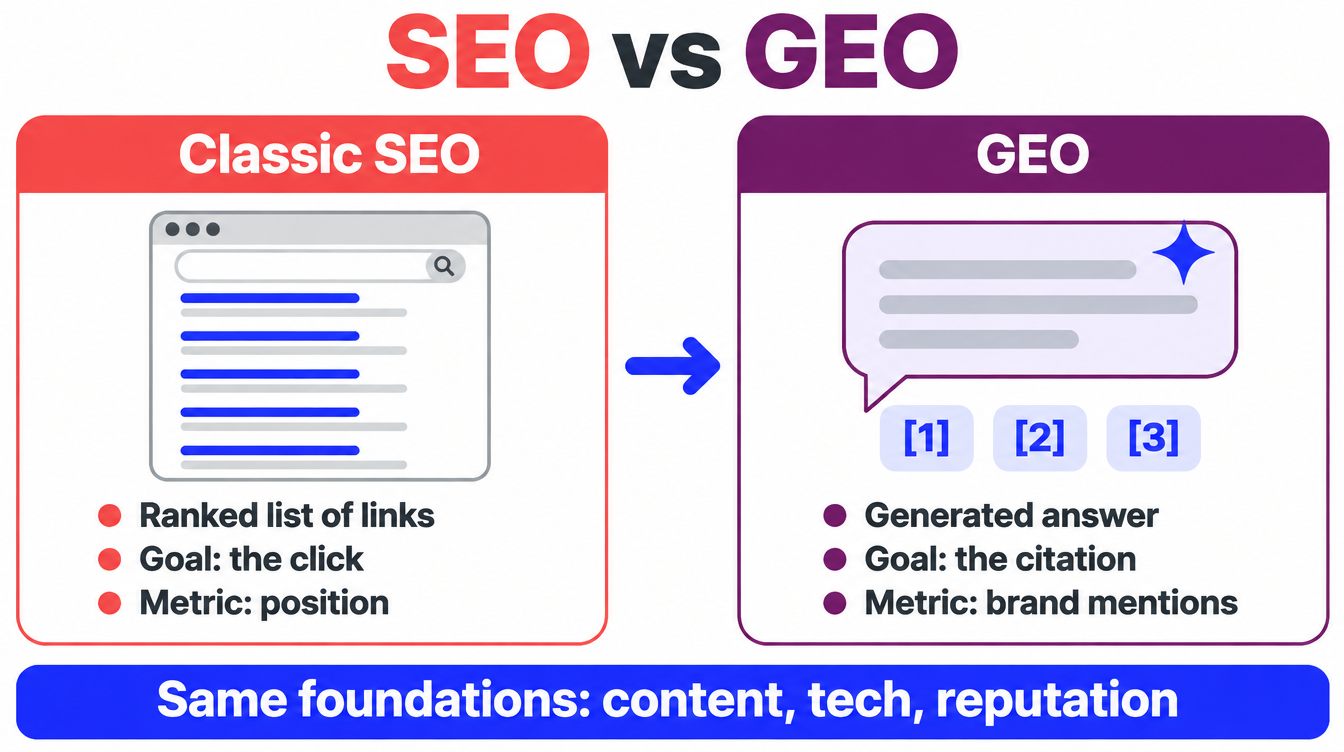
| Classic SEO | GEO | |
|---|---|---|
| Where you appear | A list of results (SERP) | Inside a generated answer |
| Goal | Ranking and clicks | Citation and brand mention |
| Unit evaluated | The whole page | The single passage of text |
| What is rewarded | Relevance, links, user experience | Clarity, verifiable data, sources, authority |
| How it is measured | Rankings, CTR, organic traffic | Citation frequency, AI referrals, mentions |
| What stays the same | Crawlability, indexing, speed, useful content, reputation | |
What the Princeton study really says (KDD 2024)
The term comes from the paper GEO: Generative Engine Optimization by Aggarwal, Murahari, Rajpurohit, Kalyan, Narasimhan and Deshpande, researchers at Princeton, Georgia Tech, the Allen Institute for AI and IIT Delhi. Published on arXiv in November 2023, it was presented at the KDD 2024 conference. The authors built a benchmark of 10,000 queries (GEO-bench) and measured how much each change to a source's text increased its visibility in the generated answer.
The 9 methods tested, with the exact numbers
The table shows the paper's main metric (Position-Adjusted Word Count: how much of the answer comes from that source, weighted by the position of the citation). The baseline without optimisation is 19.3.
| Method | What it means | Score | Change |
|---|---|---|---|
| Quotation Addition | Adding verbatim quotes from people or sources | 27.2 | +40.9% |
| Statistics Addition | Replacing generic claims with numbers | 25.2 | +30.6% |
| Fluency Optimization | Smoother writing | 24.7 | +28.0% |
| Cite Sources | Citing and linking authoritative sources | 24.6 | +27.5% |
| Technical Terms | Using the industry's technical vocabulary | 22.7 | +17.6% |
| Easy-to-Understand | Simplifying the language | 22.0 | +14.0% |
| Authoritative | A more assertive tone | 21.3 | +10.4% |
| Unique Words | More unusual vocabulary | 20.5 | +6.2% |
| Keyword Stuffing | Repeating keywords | 17.7 | −8.3% |
Source: Aggarwal et al., GEO: Generative Engine Optimization, arXiv:2311.09735 v3, Table 1. Percentage changes calculated by DAB from the table values.
Three practical lessons: content that proves (data, quotes, sources) beats content that claims; the best combination found was fluent writing + statistics, more than 5.5% better than any single technique; and the old trick of repeating keywords backfires with generative engines. The result was also confirmed on Perplexity.ai, where quotations brought roughly +22% and keyword stuffing roughly −10%.
Why GEO helps most those who are not first on Google
This is the finding almost nobody reports, and the most important one for an SME. The paper measured the effect according to the source's position in search results:
- for sources in fifth position, citing sources increased visibility by 115%, quotations by 99.7% and statistics by 97.9%;
- for sources already in first position, the same changes reduced visibility (−30.3%, −22.9% and −20.6%).
In other words: whoever already dominates classic results has little to gain, whoever is chasing has a lot. For a regional company competing with national brands, GEO is an accelerator, not a luxury.
How much AI weighs in search today: the Italian data
We work mainly with Italian companies, and the Italian market shows how fast things are moving:
- AI Overviews appeared in 22% of desktop Google searches in Italy in June 2026, up from 8% in April 2025 (Sensemakers analysis of Comscore data, reported by SmartWorld, in Italian).
- In July 2026 ChatGPT had about 9.6 million monthly users in Italy and Gemini about 9.4 million; on smartphones Gemini has been ahead since June (Vincenzo Cosenza's AI Observatory on Audicom data, via SmartWorld, in Italian).
For businesses selling B2B services or technical products the impact is even greater: complex questions ("who manufactures…", "how to choose…", "difference between…") are exactly the ones most likely to end up in a generated answer.
How a generative engine picks its sources
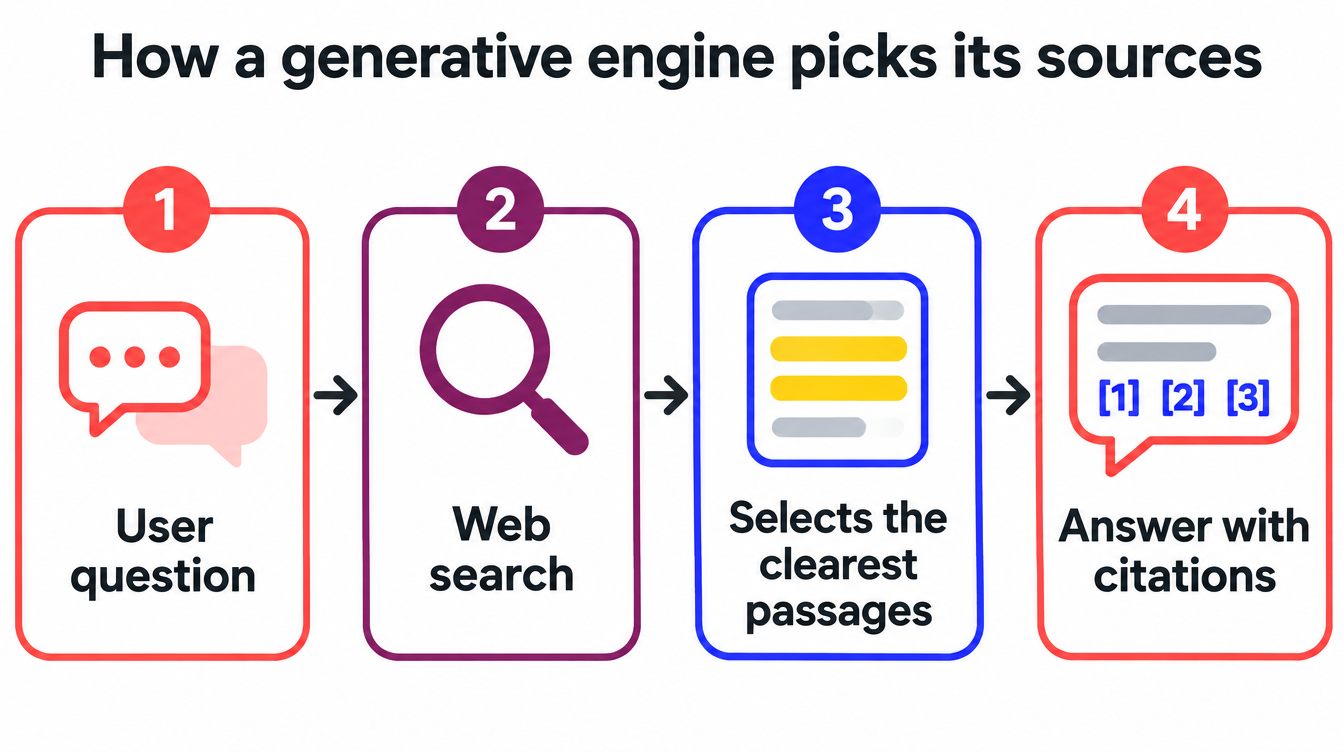
Almost every web-connected generative engine follows the same pattern, called retrieval-augmented generation: it rewrites the question into one or more searches, retrieves a set of pages, extracts the most relevant and clearest passages and writes the answer citing them. Two consequences: if you are not among the retrieved pages you do not exist, and even if you are retrieved you are cited only when one of your paragraphs answers better than the others.
Google AI Overviews and AI Mode
They use the Google Search index and its quality systems. Google is explicit: to appear, the same SEO best practices apply, the page must be indexed and eligible for a snippet, and no special files or markup are needed for AI.
ChatGPT search
It combines its own crawler (OAI-SearchBot) with external search providers, including the Bing index. That makes Bing Webmaster Tools, often neglected, important: a site well indexed on Bing is more likely to be retrieved.
Gemini, Perplexity and Copilot
Gemini relies on the Google ecosystem; Copilot on the Bing index; Perplexity has its own crawler (PerplexityBot) and always shows its sources prominently, which makes it the easiest to use for testing.
The GEO techniques that work
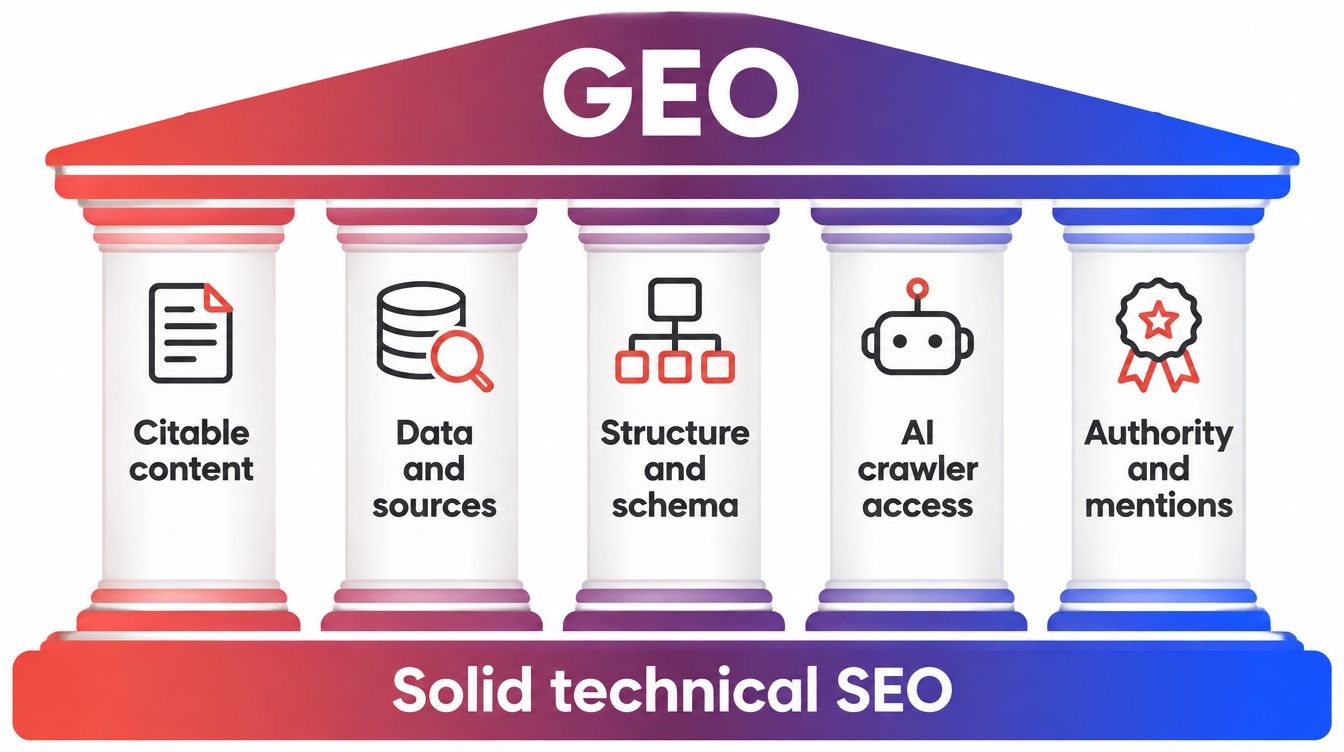
1. Answer first, in self-contained blocks
Engines cite passages, not pages. Every section should open with a sentence that answers the heading's question and still makes sense when lifted out of context. For example:
- ❌ "As we said, it depends on many factors and every case is different."
- ✅ "A professional e-commerce site for an Italian SME usually takes 4 to 8 weeks to develop; the timeline depends mostly on the number of integrations with the management system."
The "In short" box at the top of this page follows the same logic.
2. Data, quotes and linked sources
These are the three most effective changes in the study. In practice: your own numbers (years in business, projects completed, average lead times, measured results), statements attributed to real people ("according to our technical manager…") and links to primary sources such as regulations, official documentation and studies. One verifiable figure is worth more than three adjectives.
3. Structure a machine can understand
- H2/H3 headings phrased as your customers' real questions.
- Bullet lists for steps and requirements, tables for comparisons and prices.
- One topic per page, explicit definitions of technical terms.
- Important text in HTML, not inside images, sliders or PDFs.
4. Freshness and visible dates
For questions that change over time (prices, regulations, technologies) engines prefer up-to-date sources. Show the publication and update dates, and genuinely update your content: changing only the date does not help.
5. Write for the person asking, not for the algorithm
The study is clear: keyword stuffing worsens results. Write the way you would answer a customer on the phone, using your industry's vocabulary. Queries to AI are longer and more conversational than Google searches: "I need a website for my footwear company in central Italy that also sells abroad" is a real question, not a keyword.
Technical GEO: being readable by AI crawlers
robots.txt: what to block and what not to
Many sites block every AI bot "just in case" and then wonder why they never get cited. Each company runs different crawlers with different purposes:
| User agent | Owner | Purpose |
|---|---|---|
OAI-SearchBot | OpenAI | Makes the site appear in ChatGPT search. Do not block it if you want to be cited. |
GPTBot | OpenAI | Collects data for model training. |
ChatGPT-User | OpenAI | Visits requested by a user during a conversation. |
Google-Extended | Use of content for Gemini. It does not remove the site from AI Overviews. | |
PerplexityBot | Perplexity | Indexing for Perplexity answers. |
ClaudeBot / Claude-SearchBot | Anthropic | Training / search for Claude's answers. |
Bingbot | Microsoft | The Bing index, used by Copilot and as a source by ChatGPT. |
A typical configuration for a company that wants to be cited but prefers not to hand over its content for training:
User-agent: OAI-SearchBot
Allow: /

User-agent: PerplexityBot
Allow: /

User-agent: Claude-SearchBot
Allow: /

User-agent: GPTBot
Disallow: /

User-agent: ClaudeBot
Disallow: /

User-agent: *
Allow: /

Sitemap: https://www.yoursite.com/sitemap.xml
This is a choice, not an obligation: on dabmm.com we leave access open to everyone, because for an agency visibility is worth more than protecting its texts. Also check that your firewall and CDN are not blocking these bots upstream: it happens more often than you might think.
Useful structured data
- Organization or LocalBusiness with name, address, phone number and
sameAslinks to official profiles: it helps engines recognise the company as an entity. - Article with an author (Person) and dates for editorial content.
- Product, Service and FAQPage only when they match the visible text on the page.
Structured data does not guarantee a citation: it makes the information already on the page clearer. More in the Schema section of our SEO Guide 2026.
llms.txt: what it is and what it does not do
The llms.txt file is a proposal (not a standard) to give language models a tidy index of a site's content. Many guides present it as essential. It is not: Google explicitly states that AI Overviews and AI Mode do not require AI-specific text files. We publish one because it takes a few minutes and does no harm, but we do not move budget there.
Content readable without JavaScript
Many AI crawlers do not execute JavaScript the way a browser does. If text, prices or product sheets only appear after a script runs, they risk being invisible. Server-side rendering (or static generation) is the safest solution: it is why we build custom websites with Laravel and server-rendered React.
Entities and authority: getting recognised
Generative engines tend to cite brands they "know", meaning brands they find described consistently in several places on the web. For an SME this means:
- complete, up-to-date Google Business Profile and Bing Places listings;
- the same details everywhere: identical name, address and phone number on the website, listings, directories and social profiles;
- real, recent reviews, with replies;
- external mentions: local press, trade associations, trade fairs, industry portals, partners;
- an "about us" page with real people, history and demonstrable expertise.
How to measure AI citations
Measurement is the weak point of many GEO projects. Here is what you can do for free.
Google Analytics 4 and Search Console
In GA4, create a segment or exploration with the traffic sources chatgpt.com, perplexity.ai, gemini.google.com, copilot.microsoft.com and claude.ai. These are real visits that came from a citation. In Search Console, AI Overviews and AI Mode data is included in the Performance report under "Web" with no dedicated filter: watch the long, conversational queries.
Bing Webmaster Tools
Since early 2026 Bing has been rolling out an AI performance report showing citations in Copilot (Search Engine Land). It is one of the few official sources of citation data available today.
The monthly question test
The most practical method, and the one we recommend to every client:
- Write 15–20 questions your customers really ask, including the location when it matters ("best web agency in Italy for a B2B e-commerce site").
- Ask them every month on ChatGPT, Gemini, Perplexity, Copilot and Google (AI Overviews / AI Mode), in a private window.
- Record in a spreadsheet: are you cited? mentioned without a link? which competitors are cited? which pages are used as sources?
- For the questions where only competitors appear, analyse their cited pages and improve your corresponding section.
Answers vary from one session to the next: what counts is the trend over several months, not a single test. Paid tools that automate monitoring also exist (the AI modules in Semrush and Ahrefs, dedicated platforms such as Profound or Peec AI): useful beyond a certain scale, not essential to get started.
GEO for Italian manufacturers and the Marche region
We are based in the Marche region of central Italy, and we checked the GEO and AI searches for its main towns: today no local business covers the topic with its own content, and the results are taken by directories and agencies from other regions. For companies here this is a head start worth using, because AI answers reward whoever becomes a source first and stays one.
The region's manufacturing districts are a good fit, because many international B2B questions are of the "who makes" and "who can do" type:
- Footwear (Fermo and Macerata): "private label shoe manufacturers in Italy", "small-batch footwear production";
- Mechanics and automation: "precision CNC machining suppliers in central Italy";
- Furniture (Pesaro): "Italian kitchen manufacturers for contract projects";
- Yachting: "yacht interior suppliers on the Adriatic";
- Food, wine and tourism: "Verdicchio wineries with tastings", "farm stays in the Marche hills".
Each of these questions needs a page that answers directly, with verifiable data (production capacity, certifications, years in business, markets served) and consistent company information everywhere, ideally in English as well as Italian. That is exactly the work described in this guide, applied to your industry: we do it through our GEO consulting service.
15-point GEO checklist
☐ Every section opens with a direct, self-contained answer
☐ H2/H3 headings written as customers' real questions
☐ At least one verifiable figure in every key section
☐ Primary sources linked (regulations, studies, official documentation)
☐ Quotes attributed to real people in the company
☐ Tables for comparisons, prices and specifications
☐ Visible publication and update dates
TECHNICAL
☐ robots.txt does not block OAI-SearchBot, PerplexityBot, Bingbot or Googlebot
☐ Firewall/CDN checked for AI bots
☐ Main content readable without JavaScript
☐ Organization/LocalBusiness, Article and Person schema
☐ Site verified in Google Search Console and Bing Webmaster Tools
REPUTATION AND MEASUREMENT
☐ Identical name, address and phone on site, Google Business Profile and Bing Places
☐ Plan for external mentions (local press, associations, partners)
☐ GA4 segment for AI traffic + monthly question test
Mistakes to avoid and promises to distrust
- "We guarantee your presence on ChatGPT": nobody controls a model's answers. You can increase the probability, not guarantee it.
- Stuffing pages with keywords: in the study it is the only technique that reduced visibility.
- Publishing dozens of unreviewed AI-generated articles: generic content with no data of your own is exactly what engines discard.
- Blocking all AI bots without distinguishing training from search.
- Neglecting SEO to chase GEO: no indexing, no citation.
- Betting everything on llms.txt or "special AI markup".
Frequently asked questions about Generative Engine Optimization
What is Generative Engine Optimization (GEO)?
GEO is the set of techniques that increase the likelihood of a website being used as a source and cited in the answers of generative engines: Google AI Overviews and AI Mode, ChatGPT, Gemini, Perplexity and Copilot. The term comes from a study by researchers at Princeton and IIT Delhi published in 2023 and presented at KDD 2024.
Does GEO replace SEO?
No. Generative engines look for their sources on the web, so a site that is not crawled, indexed and considered trustworthy does not get cited. GEO builds on SEO: the same technical and authority foundations, but a different goal, namely being the source cited in the answer rather than the link clicked in a list.
How can I tell whether ChatGPT or Gemini cite my website?
With three free tools: in Google Analytics 4, referrals from chatgpt.com, perplexity.ai, gemini.google.com and copilot.microsoft.com; in Bing Webmaster Tools, the AI performance report; and a manual test repeated every month with the questions your customers actually ask, noting who gets cited. Search Console includes AI Overviews and AI Mode data in the Performance report without separating it.
Do I need an llms.txt file to appear in AI answers?
No. Google states that AI Overviews and AI Mode do not require AI-specific text files or special markup. llms.txt is a proposal, not a standard: it can be a tidy index of your content, but it is not a ranking factor and does not replace clear content and a technically accessible website.
Should I block GPTBot and other AI crawlers in robots.txt?
It depends on your goal. GPTBot collects data for model training, whereas OAI-SearchBot makes your site appear in ChatGPT search answers: if you want to be cited, do not block the latter. Likewise, Google-Extended controls the use of your content for Gemini but does not remove your site from AI Overviews. Blocking everything blindly means disappearing from the answers.
How long does GEO take to show results?
Content changes are picked up when engines recrawl your pages, usually within a few weeks. Brand authority, made of external mentions, reviews and consistent information, takes months to build. Be wary of anyone guaranteeing a presence in ChatGPT within days: nobody controls the answers of a model.
Is GEO worth it for a small or local business?
Yes, and the original study confirms it: GEO techniques delivered the largest gains to sites that were not in first position in classic results, with visibility increases close to double for sources in fifth position. For an SME that is not number one on Google it is one of the few chances to overtake larger competitors.
Does DAB offer GEO consulting?
Yes. DAB, a web agency based in Recanati, in the Marche region of Italy, and active since 1998, analyses how a company appears in the answers of ChatGPT, Gemini and Google AI Overviews and works on content, structured data, crawler access and measurement. The first analysis is free and without obligation, for businesses in Italy and abroad.
More answers on the FAQ page.
Want to know whether AI cites your company?
We run the question test for you on ChatGPT, Gemini, Perplexity, Copilot and Google AI Overviews, compare your visibility with your competitors' and point out the priority actions on content, technology and reputation. The first analysis is free and without obligation.
Request a free GEO analysis · GEO consulting · AI automations · Web development · +44 7469 188 144
Main sources: Aggarwal et al., GEO: Generative Engine Optimization (arXiv 2311.09735, KDD 2024) · Google Search Central, AI features and your website · OpenAI, crawlers and user agents · SmartWorld on Sensemakers/Comscore and Audicom data · Search Engine Land.